Friday, October 24, 2008

PREFAB FRIDAY: Michelle Kaufmann’s mkHearth

mkHearth, michelle kaufman, prefab farmhouse, sustainable building, sustainable housing, sustainable architecture, energy efficient housing, solar energy house, green building, green architecture

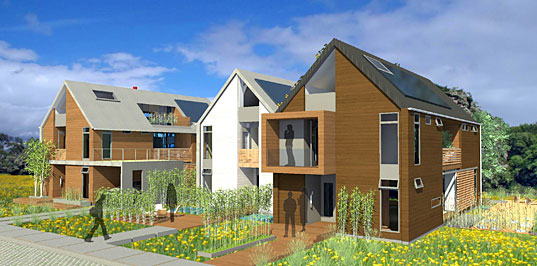
We always love seeing hot designers come out with their next hit– and Michelle Kaufmann’s new mkHearth is the latest in must-have prefab design. The home pushes the principles of green building, as her previous green homes have always done, and combines it with some countryside nostalgia to produce a prefab farmhouse. Her new prefab is both contemporary and inviting, with a slightly more traditional aesthetic which will likely prove popular with the masses. Kaufmann is responsible for many advances in green building, as well as an updated gingerbread house. Although this house is larger than most of her other designs at 2,820 sq ft, it smartly fits many rooms into that area, and even provides some flexible space with a cozy and sunny loft.

mkHearth, michelle kaufman, prefab farmhouse, sustainable building, sustainable housing, sustainable architecture, energy efficient housing, solar energy house, green building, green architecture

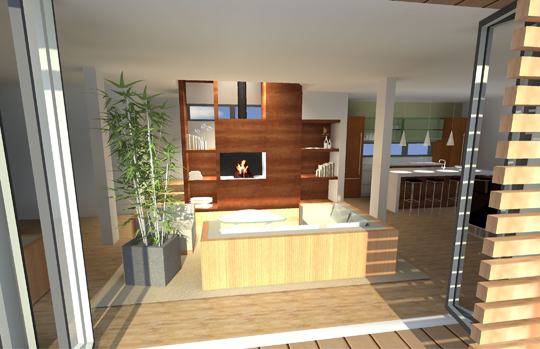
With a simple, straightforward facade, high-pitched roof, and sliding barn doors, this 3-bedroom, modern farmhouse took inspiration from traditional rural architecture. The name, mkHearth, refers to the center of the home, the hearth, from which all activity revolves. The living room and fireplace reside at the center of the bottom floor, surrounded by stairs, kitchen, office and entry. Homey details are found in the additional spaces such as window seats, reading nooks, built-in storage and screened-in porches. A flexible, loft space located on the top floor can be used as an office, playroom, workshop, studio, media room, or even an extra bedroom. We all wish we had such a snug loft to write our posts from!

mkHearth, michelle kaufman, prefab farmhouse, sustainable building, sustainable housing, sustainable architecture, energy efficient housing, solar energy house, green building, green architecture, mkhearth loft

As always, this Kaufmann prefab is designed to be sustainable, energy efficient, and low-maintenance. For minimal environmental impact and to create a healthy living space, the mkHearth includes high-performance insulation and mechanical systems, passive solar design (with proper orientation), dual pane low-E glazings, low-VOC paints and finishes, eco-friendly furnishings, solar pv options, water-conserving fixtures, and rainwater collection.

Kaufmann also hopes that someday these homes will be developed into a sustainable neighborhood. Check out the videos for a walk through of the homes.

+ Michelle Kaufmann Designs

+ Michelle Kaufmann Blog

mkHearth, michelle kaufman, prefab farmhouse, sustainable building, sustainable housing, sustainable architecture, energy efficient housing, solar energy house, green building, green architecture, mkhearth interior

mkHearth, michelle kaufman, prefab farmhouse, sustainable building, sustainable housing, sustainable architecture, energy efficient housing, solar energy house, green building, green architecture

mkHearth, michelle kaufman, prefab farmhouse, sustainable building, sustainable housing, sustainable architecture, energy efficient housing, solar energy house, green building, green architecture

mkHearth, michelle kaufman, prefab farmhouse, sustainable building, sustainable housing, sustainable architecture, energy efficient housing, solar energy house, green building, green architecture, mkhearth floorplan

Tuesday, May 6, 2008

CO2 SAVER: Sustainable Lakeside House in Poland

by Jason Sahler


Optimizing passive solar gain and using untreated local wood, this sustainable home on Lake Laka in Poland was designed by architect Piotr Kuczia. The south side soaks up the sun reducing the amount of active heating, while the north side opens up to vistas of the lake. Many of the materials were locally sourced, reducing the amount of unnecessary transport required for construction, hence the moniker CO2 saver. But there are many other ways that this home saves on CO2.

The CO2 Saver utilizes several passive solar techniques, with close to 80% of the structure facing the south as well as the charcoal colored fibre cement covering the central structure. The materials on the inside, such as the concrete floor, also have a high thermal mass allowing for less of a need of active mechanical control. The home also has two green roofs on either side of the “black box”. Got to love green roofs.

The self titled “Chameleon” house seems right at home in the beautiful setting around Lake Laka. In Kuczia’s own words, the home “blends with its surrounding area on Laka Lake in Upper Silesia. Colourful planks within the timber façade reflect the tones of the landscape.”

Of course there are some innovative technologies to complement the rest of the decidedly lo-tech home, including intelligent building control systems, solar heating and ventilation with energy recovery. There are also plans to add solar panels for energy in the near future. Now all we need to do is get a solar oven to bbq some vegan burgers, some lawn chairs, a nice cold one and I would call that an environmentally-friendly day at the lake.

(Source: Inhabitat)

Saturday, May 3, 2008

The Salt House


Alison Brooks Architects wins the RIBA Manser Medal for The Salt House in Essex The Salt House is a rare example of a contemporary UK sea-side house. Constructed as a weekend retreat and future home to retire for the owners, Salt House carries forward the Modernist tradition of the experimental ‘beach house’ as a vehicle to explore new architectural possibilities- site specific yet containing the potential for wider application. Extensively published in this country and abroad, The Guardian’s Architecture critic Jonathan Glancey described The Salt House as “one of the best new houses in Britain today”. In 2006 the house won the Grand Designs Award for the Best New Build House of the Year and has recently been awarded the 2007 RIBA Manser Medal. The client for Salt House is a couple whose parents live in the house next door, and the client spent all her summers there as a child. It is a new house with a long history! This project benefited from a quite specific client brief in terms of functionality – 3 beds/baths + guest suite, 3500sf, no swing doors, a £450K budget - but complete openness in terms of form and materials. The client was interested in the atrium house typology, and in particular a strong visual connection from 1st floor to ground floor due to the special needs of one of the clients two children. The project had the added demand of fulfilling the requirements of new building in a high-risk flood plain. We embraced these challenges, aiming to design a house sympathetic to its context - yet responding in a fully contemporary manner to the opportunities of a family ready for modern sea-side living. The two storey Salt House is located at the end of a terrace of 19thC timber-boarded oyster fishermen’s houses fronting a communal garden sheltered by a sea wall. Department of the Environment floodproofing measures required lifting the house above the level of its neighbours; this higher elevation means the house forms a ‘bookend’ to the terrace, balanced by the inn at the terrace’s opposite end. The form and geometry of the house re-interprets the local vernacular of hipped roof, bay windowed cottages. The façade ‘bends’ so that the entire north and south facing facades effectively become ‘bay windows’, maximising sea views to the north and passive solar gain from the south. The manipulation of the facades in turn deflects the geometry of the hipped roof to create an irregular, crystalline form. The three dimensional facade acts as an instrument for engaging with the communal garden, the land and seascape, while expressing the dynamic forces of the extreme North Sea weather. Framing the south facing entrance courtyard, the traditional single storey ‘outrigger’ typical of the lane entrances to the oyster cottages, naturally became a family room/guest wing. The house has neither a front nor a back per se. Both facades are highly glazed, permeable screens allowing cross ventilation and views through the house. Window and balcony openings travel freely across the facades expressing lightness and movement. The exterior walls and decks are clad in Ipe, a durable hardwood from sustainable forests that gives the house a silvery weathered shine. The roof is finished in synthetic slates, matching neighbouring roofs while enabling precision cutting around gutters, eaves and rooflights. Maldon Council was surprised and pleased with The Salt House proposals, exhibiting the project in a local exhibition of exemplary new architecture in Essex, and inviting the scheme to be submitted for local awards. Inside, interconnected spaces are ‘wrapped’ by wall and ceiling planes. The ground floor of the building is conceived as a continuous landscape that steps up from the entrance courtyard to the south facing timber deck. Huge sliding doors lead to the slate floored central atrium, ‘folded’ staircase and a sunken living area with a fireplace wall that extends outside to the deck, garden and beach. Upstairs, a second living space and study is bathed in light from the central atrium rooflight, with elevated views of the Blackwater Estuary to the west and St Lawrence harbour to the east. The space is framed by a series of folded element– the timber balustrades of the mezzanine fold downward to create the staircase, while the facetted walls of the 1st floor bedrooms are extensions of the trapezoidal rooflight geometry. From the very earliest stages, Maldon Council’s planning department was supportive of the scheme but required a full Flood Risk Assessment which was produced as part of the Planning submission. The design integrates extensive wet-proofing and dry-proofing measures, the most important of which was elevating the concrete slab on mini-piles. Not only do the mini-piles allow below ground water to flow past, reducing hydrostatic pressure on the foundations, they reduce site spoil to zero and, in the eventuality of long-term water level changes, the house can be jacked up to a higher level. Given this context Salt House is a prototype for flood-proof residential construction. The house is based on the structural principle of an elevated slab as the base for a steel portal frame. This allows two stories of column free interior space, corner windows, and a huge central rooflight opening, which doubles as a ring beam. Timber framing between steel elements is sheathed with marine ply to stiffen the entire frame. The owner describes Salt House as ‘a ship ready for the worst the North Sea can throw at it!’ A local builder’s craftsmanship, open-minded clients, and an attempt to sensitively transform a familiar local typology roots Salt House in time, place and family history.

(ashui)

Water and wood in Mexico City

La Loma II is a project that cohabits with natural elements like water and wood, being these protagonists of the access area that embraces the house. The water is use as a ornamental element of cylindrical form contained by steel walls, and a tropical wood lattice window that acts like protective skin isolating the house from the outside. The great majority of the service area is located in the cellar, under the street level, giving the feeling of a two level house leaving a 260 m2 of green areas. The complementary areas of the house are developed in a “L” shape 7O5 m2 that integrates to the garden. As a means of the separation of two volumes that uproot the construction in different angles, a lobby of double height forms and a tunnel of crystal floating to the center unites both bodies of the construction. The composition of areas, volumes, forms and textures in the facades is obtained through different compound and interconnected elements. The use of the continuous crystal towards the garden speaks of the transparency without sacrificing privacy, reason why in its north wing, the dining room is only contained by glass and its slab maintained by columns exposed in a "V" shape fusing it with the garden and water. A challenge, was the slab - curve cover, that is drawn end to end of the house, tap of a single piece of colored concrete exposed as a finished material apparent in its two sides.


Architects Realize Three Unique Visions for the Ultimate Pool Pavilion

Text by Joseph Giovannini

Frank Lloyd Wright never just plopped a house on a passive piece of land. He found ways to activate the yards, often with garden walls that reached from the house into the landscape. But the architect, eyes twinkling as he made mischief, noted that to activate the front yard, one just places the mailbox at the street, to guarantee a daily stroll across the lawn.

Swimming pools were not yet rampant in the American home in Wright’s time, but since then, homeowners with pools have been getting more bang from their pond by building poolhouses with more than just changing rooms. A pool pavilion can be a vacation home on the same property. A mailbox at the street and a poolhouse in the back activate both yards, property line to property line.

It shades the shallow end and hovers over one side of the pool so that the deck of the pavilion appears to float on water.

Poolhouses equipped with some combination of a kitchen, a bar and seating and media areas may be a recent phenomenon, but since the Renaissance, there has been a long and related architectural tradition of pavilions and follies in the garden. They were oneiric or just practical—Romantic ruins triggering thoughts of an idealized classical past or greenhouses where glass walls offered plants and people warmth out of season. The history of garden follies and pavilions suggests that architects can tilt the poolhouse toward delight, creating a structural confection of great invention, like a fantasy dessert.

When the New York firm Hariri ’ Hariri—Architecture was asked to design a poolhouse in suburban Connecticut, the architects quickly concluded that the aesthetics should be a primary focus. “It was going to dominate the view from our clients’ house, so it had to be sculptural—you’re constantly looking at it,” says architect Gisue Hariri.

Some sculpture is figural and closed, like a statue, but Hariri and her sister Mojgan borrowed from a tradition of open form dating from early Modernism, creating an angular archway that parallels the entire length of the lap pool. “We used the arch to frame the landscape, so your eye travels through,” says Gisue Hariri.

The architects designed the arch to relate intimately to the pool. It shades the shallow end and hovers over one side of the pool so that the deck of the pavilion appears to float on water. There are tall and short, wide and narrow, indoor and outdoor spaces, with steps up and down, which create diversified areas for socializing, dining, sunning, lounging or just dangling feet. “Instead of isolating the pool, we created an interactive association knitting the house and the water,” says Hariri. In one continuous gesture, the floor plane turns up at the end as a wall and then turns again to become the roof.

Architectural history is not teeming with poolhouses. But on the grounds of the old Delta Plantation in South Carolina along the Savannah River, the context—including a traditional brick mansion, with oak trees dripping Spanish moss—and the desire of its owners, an insurance executive and his wife, to entertain, suggested a classicized pavilion to house an indoor lap pool. “Everything began with the site,” says project designer Terry Pylant. But the site took him and design principal Jim Strickland—both of Historical Concepts, of Peachtree City, Georgia—far away, to Palladian villas, which had influenced plantation houses, and to orangeries.


They bookended the lap pool with a bath area and a fireside lounge. A long skylight parallels the pool. A bank of French doors on either side admits light all year round, and they can be opened in clement weather, as in traditional garden pavilions. Ironically, this evocative poolhouse, of remote historical provenance, is technologically complex, with two climate systems, for dehumidification and temperature.

Across the continent, David Kesler, a Berkeley architect, was asked by David and Cristy Clarke to design a poolhouse on a property in suburban Orinda, California, with a traditional two-story shingled house and an oval pool set against a picturesque tumble of boulders, all nested within a sylvan setting bordered by a dense mantle of trees. The main house suggested tradition, but instead the clients wanted the Modernist architect to design a Modernist structure, in the spirit of follies that add something different to existing contexts. “They wanted sculpture,” says Kesler. “They were pushing art.”

At first the architect proposed a Cubist structure, but the distorted forms were too chaotic for the clients: “They preferred a fluid line that would sit softly in the landscape,” he says.

The answer to what the design wanted to be was right in the yard. Kesler took the shape of the pool and transposed the geometry to the roof of the poolhouse. The oval shape cantilevers forward over the patio like the visor of an enthusiastic baseball cap. The play of shapes recalls Richard Serra’s famous Torqued Ellipses. Made of poured concrete, the enclosed pavilion itself anchors the roof and contains a living area, a bath and a kitchen. “We used reinforced concrete, because it feels raw and primitive and because it’s a very fluid, abstract material.” Cherry cabinetry and paneling warm the space.

Practically speaking, the poolhouse is a liberating building type, because, as with lofts, the functions are flexible, and architects can work this small building into a cross between an architectural thesis and a jewel. Gisue Hariri says, “I’m hoping that we’ll see more of this integration of the pool and poolhouse, not as an afterthought, like a pool with a garage, but as a main focus of the landscape.”

(Source: Architectural Digest)

Wednesday, April 30, 2008

OLD STONE HIGHWAY HOUSE: Modern future forward design


Founded in 2001, Berg Design offers gorgeous sustainable solutions to residential projects. Their Old Stone Highway house was designed by John Berg as a “Single Family Residence with Environmentally Low Impact Building Technology”. We totally dig their uncompromising approach to housing that is luxurious, super green, and chock full of mid-century charm.


Surprisingly, this sleek sustainable haven draws its inspiration from a Long Island barn built in the 1800’s. Completed in July 2007, the Highway House was conceived as a “modern interpretation of the Long Island agricultural vernacular”. It’s an elegant marriage of glass, western cedar siding, and concrete block interspersed with large windows that bring the outside in, suffusing the interior spaces with a lovely use of natural light.

The innovations are in the details: the house makes use of high performance Structural Insulated Panels (SIPS) that are airtight, well insulated, and quick to assemble. These panels are complemented by a 98% efficient boiler, radiant concrete floors and a geo-thermal HVAC system. The ubiquitous windows fold open during warm weather, and are composed of dual-pane low-e glass filled with argon gas, while the roof is constructed with tough, UV-resistant Kynar. Energy Star appliances and a saline pool (no chemicals!) round out a house that mixes classic lines with the latest in eco-tech.

+ Berg Design Architects

Source: Inhabitat

Architect Aalto remains timeless

Source:Viet Nam News

The unique work of world-famous Finnish architect and designer Alvar Aalto (1898-1976) is taking the spotlight at a new exhibition which opens today in Hanoi and later in HCM City.

The show, titled Alvar Aalto Houses - Timeless Expressions presents a slice of the Finnish designer's life work, including 17 of the total 100 residential houses he designed, with examples from different stylistic periods between 1924-1972. The buildings are presented through a selection of photographs, architectural drawings and scale models. Some of Aalto's furniture and other forms of art are also on display.

Aalto's pieces derive their special aesthetic character from dynamic relationship with their natural surroundings as well as their scale, immaculate details, treatment of materials and use of lighting.

The architect was well-known for his desire to improve the world with better living spaces, summed up in one of his most famous quotes: "Architecture cannot save the world, but it can set a good example."

After graduating from Helsinki University of Technology with a degree in architecture in 1921, Aalto dabbled in the latest trends in international furniture design before finding his own voice expressing the organic relationship between man, nature and buildings.

As early as 1930 his architecture and design showed an exceptional modern approach, which remain a source of inspiration to modern architects all over the world.

The exhibition is on at the VietArt Centre, 42 Yet Kieu, Hanoi until May 1 and will open at the City Hall for Exhibitions, 92 Le Thanh Ton, District 1 in HCM City from May 12-16. It is co-organised by the Embassy of Finland, the Viet Nam Association of Architects and the Alvar Aalto Museum.


Image by Kalevi A. Makinen, courtesy of the Barbican Art Gallery (inhabitat.com)


Image by Judith Turner, 2006, courtesy of the Barbican Art Gallery (inhabitat.com)


Image by Hiroyuki Hirai, courtesy of the Barbican Art Gallery (inhabitat.com)


Image by Hiroyuki Hirai, courtesy of the Barbican Art Gallery (inhabitat.com)

Tuesday, April 29, 2008

VH R-10 gHouse

The late architect John Hejduk.
Compact and spare, the VH R-10 gHouse, created by the architect for himself and his wife, is full of personal touches.


Restrictive zoning, rather than necessity, is often the mother of architectural invention. Made to withstand the harsh winters of Martha’s Vineyard while treading lightly on the island, the VH R-10 gHouse, designed by architect Darren Petrucci, AIA, was so profoundly shaped by local restrictions that it adopted the zoning district—R-10—as part of its name.

Even though Martha’s Vineyard was originally (and still is) home to the Wampanoag Indians, it put itself on the map in the 19th century during the rise of the whaling industry. Today, the island is best known for its pristine beaches and quaint New England villages, and has firmly established itself as a summer colony and magnet for the rich and famous. Petrucci and his wife, Renata Hejduk, an assistant professor of architectural history and theory at Arizona State University, in Tempe (and daughter of the late John Hejduk), were drawn to the Vineyard for the same reasons that have attracted other vacationers. The couple, who spend most of their time in the Phoenix area, were not interested in a beach house or isolated retreat, however. Petrucci, the director of Arizona State University’s School of Architecture + Landscape Architecture, where he also runs a research and design lab that focuses on urban amenities and infrastructures, hoped to build a high-performance prototype house incorporating contemporary building techniques within walking distance of one of the island’s towns. When he and his wife learned of a lot for sale on the outskirts of Vineyard Haven, a community of traditional 19th- to mid-20th-century wood-shingled buildings, they jumped on the rare find.

The gently sloping corner property was appealing on a number of counts. At 12,518 square feet, it just met the zoning requirement to legally accommodate both a main house and a guesthouse. With economy and the future value of the lot in mind, the couple opted to build a guesthouse first, reserving the right to build a larger main house later. However, local zoning restrictions are rigid: Guesthouses in the district, for example, may encompass no more than 600 square feet, their height may not exceed 24 feet, and a particularly ornery clause stipulates that the basement may not be accessed from the building’s interior.

To maximize the allowable envelope, Petrucci drew a 16-by-40-by-24-foot box based on a 4-foot construction module. Structurally insulated panels (SIPs) enclose three staggered, rectilinear volumes for cooking, living, and sleeping. Though the center volume is shifted out 4 feet to accommodate an exterior stair, a mahogany rain screen unifies the volumes, enveloping the stair and blurring the line between outside and in. The program called for a kitchen, living area, and master bedroom on the main level. The small loft and spacious lower-level guest suite do not count toward the square footage allotted by zoning so, cleverly, 600 technical square feet become 1,000 square feet of livable space. A raised deck, accessed by the exterior stair, creates a secluded aerie in the tree canopy.

(By Beth Broome - This is an excerpt of an article from the April 2008 edition of Architectural Record.)

Number One

We belong to the world we belong to the wind
We are the spirit of competitions end
Turning hours into days burning muscles feel the pain
The heart and soul of discipline my friends
We are sending you a challenge its very clear
We came to win that is why we are here
Demanding to be tested by the best
Not to be forgotten like all the rest
The time has come all training done
The muscle and the blood will come to pay
Let the game begin hear the starting gun
Play from the heart today we will overcome
When the game is over all the countings done
We were born to win number 1
Today is the day all the training through
We have come for the number one not the number two
Let the contest begin play hard fight to win
Immortality victory and fame
The time has come all training done
The muscle and the blood will come to pay
Let the game begin hear the starting gun
Play from the heart today we will overcome
When the game is over all the countings done
We were born to win number 1
Today is the day all the training through
We have come for the number one not the number two
Let the contest begin play hard fight to win
Immortality victory and fame
Let the game begin hear the starting gun
Play from the heart today we will overcome
When the game is over all the countings done
We were born to win number 1